
 Back to blogs
International Yoga Day 2026: How Technology is Changing the Way We Practice Yoga
 Manisha
Every year on June 21, millions of people around the world roll out their mats, take a deep breath, and move together on International Yoga Day. From packed parks in Delhi to quiet living rooms in São Paulo, the day has become a global reminder that yoga is not just an ancient practice, it is a living, evolving tradition.
But let’s be honest about what most people’s day actually looks like: eight or more hours at a desk, a commute that adds another hour of sitting, and evenings too drained for much else. Stress, screen fatigue, and poor posture have become the defining health concerns of modern life. Yoga offers real, evidence-backed relief for all three but the challenge has always been getting started and staying consistent without a teacher standing in the room with you.
That is where technology is quietly changing the game. Online yoga classes, AI-powered posture feedback, and personalised digital programmes are making yoga more accessible, safer, and easier to stick with than ever before. This International Yoga Day, it is worth understanding both why yoga matters more than ever, and how modern tools are helping people actually practice it.
What is International Yoga Day?
International Yoga Day 2026 will be celebrated on Sunday, June 21, marking the 12th global observance of this event. The day highlights the importance of yoga in promoting physical health, mental balance, and overall well-being.
The idea of International Yoga Day was first proposed by Narendra Modi in 2014 and was later adopted by the United Nations General Assembly, making it a globally recognized occasion.
In recent years, International Yoga Day has expanded beyond a single-day celebration. Initiatives led by the Ministry of AYUSH now include a 100-day countdown featuring awareness campaigns, community events, and mass yoga sessions to encourage wider participation across the globe.
Regular yoga practice can make a noticeable difference in how you feel, both physically and mentally. Some key benefits include:
- Helps reduce stress and anxiety
- Improves posture and overall flexibility
- Supports better sleep quality
- Boosts mental clarity and overall well-being
Why Yoga Is Important in Modern Life
Mental health in a distracted world
Research consistently links regular yoga and breathwork (pranayama) to reduced cortisol levels, lower anxiety, and improved sleep quality. For anyone juggling deadlines, notifications, and a never-quiet inbox, even a 20-minute session can meaningfully shift the nervous system out of its fight-or-flight state.
The posture crisis nobody is talking about
Prolonged sitting is reshaping the way people carry themselves literally. Rounded shoulders, a forward head position, and lower back stiffness are now so common they have their own clinical term: “tech neck.” Posture correction yoga, which focuses on spinal alignment and hip-flexor release, has become one of the fastest-growing search categories in digital wellness. The body responds well and relatively quickly, most people notice a difference within a few weeks of consistent practice.
Yoga for beginners: finally breaking the intimidation barrier
For a long time, yoga had an image problem. Studios could feel unwelcoming, advanced poses dominated social media, and beginners often felt they needed to be flexible to start. The shift toward digital platforms has quietly dismantled that barrier. Yoga for beginners is now one of the most-searched wellness terms online, and the demand is only growing.
Traditional Yoga vs Modern Challenges
The principles of yoga are breath awareness, alignment, and presence have not changed. What has changed is the context in which most people are trying to practice.
A traditional studio class offers something invaluable: a teacher who can see you and correct you in real time. But studios are not accessible to everyone. Cost, location, timing, and social anxiety are genuine barriers, particularly for beginners who are not yet sure yoga is for them.
Many people turn to YouTube as a starting point. It is free, convenient, and there is no shortage of content. But it comes with a significant limitation: the video cannot see you back. You can follow along with a 30-minute flow and spend the entire time with your knee misaligned in Warrior II, reinforcing a pattern that will cause pain over time. Without feedback, practice can ingrain poor habits as easily as good ones.
“I practiced yoga on YouTube for six months and my lower back actually got worse. I had no idea my form was so far off until I got real guidance.” — A common experience among self-taught beginners.
Inconsistency is the other major challenge. Most people start with genuine enthusiasm, miss a week, feel disconnected, and quietly stop. Without structure, accountability, or a sense of progress, the habit rarely sticks.
The Rise of Technology in Yoga
The global online fitness market grew dramatically during and after the pandemic, and yoga was one of the biggest beneficiaries. What started as a stopgap — streaming classes because studios were closed — turned out to suit a lot of people’s lives better than the studio model ever had.
- Online yoga classes removed the commute, the fixed schedule, and the social pressure of a physical room.
- Mobile apps introduced structured programmes — something a random YouTube playlist could never offer.
- Virtual live sessions brought back the real-time element that recorded videos lacked.
- Progress tracking gave practitioners a sense of movement and momentum, which turned out to be crucial for consistency.
The next step was personalisation. The more a platform could tailor a practice to an individual’s goals, fitness level, and schedule, the more likely that person was to keep showing up. This is where AI entered the picture.
How AI is Transforming Yoga Practice
Real-time posture correction
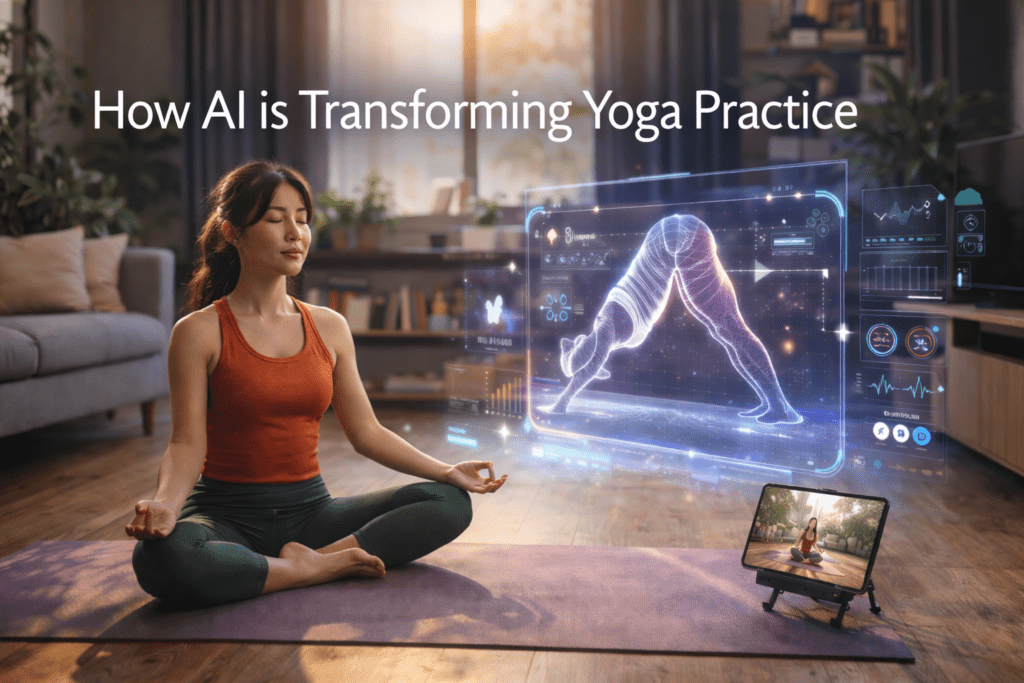
The most significant development in digital yoga is AI-powered posture monitoring. Using the camera on a phone or tablet, newer platforms can track a practitioner’s body position in real time and flag when something is misaligned a knee going past the toes in a lunge, hips dropping in a plank, or shoulders creeping toward the ears in a forward fold.
This addresses the single biggest limitation of home practice: the absence of a teacher’s eye. It is not a replacement for a great instructor, but for someone practicing alone at 7am, it is a meaningful safety net — especially for beginners who are still building body awareness.
Personalised plans that adapt
AI also makes it possible for platforms to build yoga programmes that adjust based on what a user actually does, not just what they say they want. If someone consistently skips meditation and completes every strength-focused session, the system notices. If someone’s posture data suggests tight hamstrings, the plan can prioritise the relevant stretches. This kind of quiet, data-driven personalisation has historically been the preserve of one-to-one coaching. Technology is making it scalable.
Some newer platforms like Yogain Wellness, which combines live teacher-led classes with AI posture feedback — represent this blend well. The teacher brings warmth, structure, and expertise; the AI adds the observational layer that a recorded video simply cannot.
Progress tracking that keeps you honest
Gamification, streak tracking, and milestone recognition may sound superficial, but the behavioural science behind them is solid. External markers of progress help bridge the gap between starting something and building a genuine habit. For yoga beginners especially, a visual record of consistency can matter more than the physical results, which take longer to show up.
Benefits of Tech-Enabled Yoga for Beginners
If you are new to yoga and wondering whether a digital platform makes sense for you, consider three things:
Convenience that removes the excuse
Practicing at home, on your schedule, without needing to book a class or commute anywhere removes the most common reason people give for stopping: “I just couldn’t find the time.” A 20-minute session before work is genuinely possible when the studio is your living room.
Safety through feedback
Posture correction yoga is not just about aesthetics — misaligned practice can cause real injury over time. Beginners are most vulnerable because they are still learning to feel what correct alignment actually feels like from the inside. Real-time AI feedback provides an external reference point until that internal awareness develops.
Structure that builds consistency
A structured programme removes the daily decision of “what should I do today?” — which, for beginners, is often the decision that leads to doing nothing. A curated sequence that builds logically over weeks gives a beginner a path to follow, not just a library to scroll through.
Global Celebrations and Themes of Yoga Day 2026

Each year, International Yoga Day is celebrated with themes that highlight different aspects of health and well-being. While the official theme for 2026 is yet to be announced, recent events have focused on mindful living, holistic health, and the role of yoga in building a balanced lifestyle.
These celebrations extend far beyond India, with millions of people participating through public events, online sessions, and guided programs, making it a truly global movement.
Tips to Start Your Yoga Journey This International Yoga Day
June 21 is a natural starting point. Here are a few principles that will serve you better than any specific pose sequence:
- Start smaller than feels necessary. Three sessions a week of 20 minutes each will do more for you than one ambitious 90-minute session followed by three weeks of guilt. Sustainability beats intensity.
- Prioritise alignment over depth. In every pose, the goal is not to go as far as possible, it is to go as far as you can while maintaining correct form. This is where guided systems genuinely help.
- Use structure to take the decision fatigue out of it. Whether that is a progressive online programme, a live class schedule, or an AI-assisted app, having a plan reduces the number of choices standing between you and your mat.
- Track your consistency, not your performance. The question is not “was I flexible today?” but “did I show up?” Consistency over months is what produces the results.
- Be patient with the mental benefits. Physical changes take weeks. The nervous system benefits — a calmer baseline, better sleep, reduced anxiety — often arrive sooner, but subtly. Pay attention.
Conclusion:
Yoga has survived thousands of years because of its core principles, breath, awareness, alignment, presence, work. International Yoga Day exists to remind us of that and to invite more people into the practice.
AI posture monitoring, live online classes, and personalised programmes do not replace a great teacher but they extend that teacher’s reach to people who could not otherwise access them.
Start Your Yoga Journey Today 🧘♀️
Ready to begin this International Yoga Day? Try AI-guided online yoga classes with a
10-day free trial — no credit card required. Cancel anytime.
No risk. No commitment.
FAQS – International Yoga Day 2026
What is the theme for Yoga Day 2026?
The official theme for International Yoga Day 2026 has not been announced yet. Each year, the theme is released by the government closer to June 21.
Why is June 21 celebrated as Yoga Day?
June 21 is celebrated as Yoga Day because it is the longest day of the year in the Northern Hemisphere and holds spiritual significance in yoga traditions.
Can yoga reduce BP?
Yes, regular yoga practice can help reduce blood pressure by lowering stress, improving circulation, and promoting relaxation.
Who is the father of yoga in India?
Patanjali is considered the father of yoga in India, known for compiling the Yoga Sutras, a foundational text of yoga philosophy.
What is AI yoga?
AI yoga uses technology to provide real-time posture correction and personalized yoga programs.
Explore more blogs
View all blogs
April 7, 2026
10 Yoga Poses for PCOS That Can Improve Hormones Naturally
PCOS (Polycystic Ovary Syndrome) is one of the most common hormonal conditions affecting women today. It can lead to symptoms like irregular periods, ...

April 7, 2026
Yoga Before or After Workout? The Exact Timing Guide Based on Your Goal
Should you do yoga before or after a workout? For most people, yoga is best done after a workout. Post-workout muscles are warm and pliable, making ...
April 1, 2026
Best Online Yoga Classes Near You: What to Look for Before You Join
A few years ago, if someone had asked how to find yoga classes nearby, the answer would have been simple. You would search for a studio in your area a...