
 Back to blogs
How AI Is Revolutionizing Yoga Today — And What’s Next
 Manisha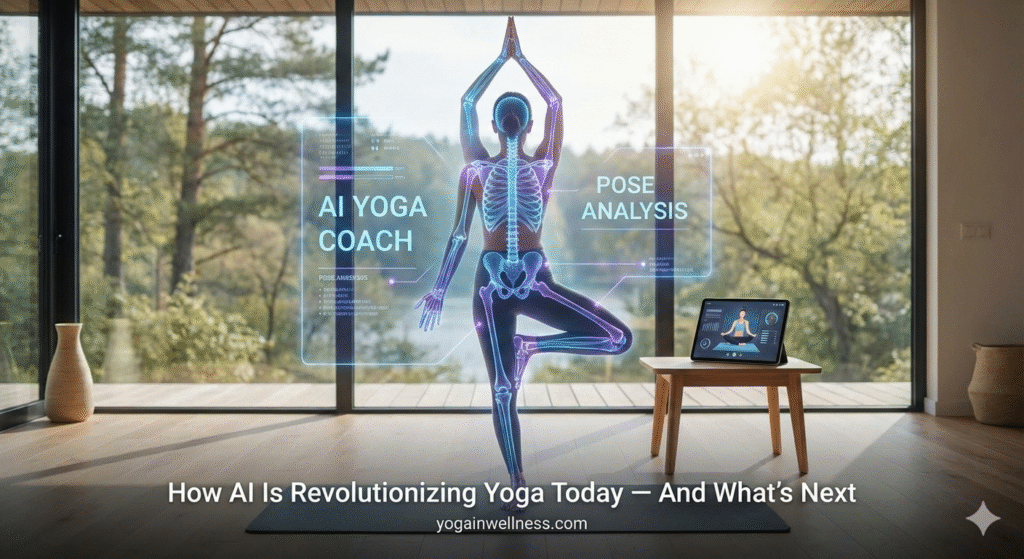
Why the Future of Yoga Depends on Remembering What Yoga Actually Is
The headlines are everywhere. AI is transforming yoga. Smart mats track your balance. Apps generate custom sequences. Chatbots offer spiritual guidance. Wearables monitor your heart rate during savasana.
But in all this excitement about what technology can add to yoga, we need to ask a more important question. What might we be losing?
I have been teaching yoga for over a decade. I have watched technology transform how people discover, practice, and share yoga. Some changes have been genuinely helpful. Others miss the point entirely.
The truth is this. Technology can support yoga practice, but it cannot replace the essence of what makes yoga transformative. And if we are not careful, we risk turning an ancient practice of self-discovery into just another app notification competing for our attention.
Let me explain what I mean.
The Promise of AI in Yoga (And Why It Matters)
Technology has made yoga accessible to millions who would never have found it otherwise. This is genuinely important.
Someone living in a rural area with no yoga studios nearby can now learn from world-class teachers. A person with mobility limitations can find adapted practices through online platforms. A student on a tight budget can access free classes instead of expensive studio memberships.
AI takes this accessibility further by offering personalization at scale. An app can theoretically design a practice based on your specific needs, time constraints, and physical limitations. It can provide alignment feedback when you practice alone at home. It can track progress and suggest modifications.
These are real benefits. I am not dismissing them.
But here is what concerns me. In our rush to make yoga more convenient, efficient, and data-driven, we risk reducing it to just another wellness product optimized for engagement metrics.
What AI Gets Right About Yoga Practice
Let me be fair. There are legitimate ways technology supports yoga.
Sequencing and Class Design
AI can generate yoga sequences quickly. If you need a 20-minute hip-opening flow or a 45-minute class focusing on back pain relief, an app can build that for you instantly.
This can be genuinely helpful for teachers looking for inspiration or students who want variety in their home practice. The technology understands basic principles of warm-up, peak poses, and cool-down. It knows which poses prepare the body for others.
For someone just starting yoga or exploring different styles, having access to diverse sequences can accelerate learning. You can try vinyasa one day, yin the next, and restorative the day after to discover what resonates with you.
Alignment Feedback for Home Practice
When you practice alone, you cannot see yourself. Is your spine neutral? Are your hips level? Is your weight distributed evenly?
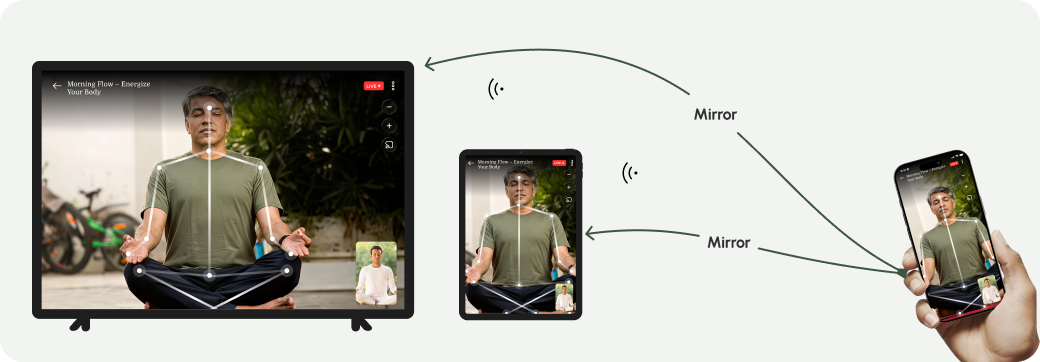
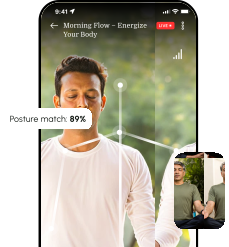
Computer vision technology can analyze your body position through your phone camera and offer feedback. For someone learning basic poses without a teacher present, this can prevent injury and build better body awareness.
I have had students tell me they appreciate having alignment guidance when practicing at home between classes. It helps them feel more confident in their practice.
Physiological Tracking and Body Awareness
Wearable devices track heart rate, breathing patterns, and sleep quality. This data can provide insight into how your practice affects your nervous system.
For example, if you notice your resting heart rate decreasing over weeks of consistent practice, that is tangible evidence of how yoga affects your stress response. If your sleep improves, the data confirms what you might already feel.
Some students find this information motivating. It makes the benefits of practice visible in concrete ways.
Access to Knowledge and Philosophy
Large language models can synthesize vast amounts of information about yoga philosophy, anatomy, and technique. If you have a question about a specific concept from the Yoga Sutras or want to understand the biomechanics of a particular pose, you can get detailed explanations instantly.
This democratizes access to knowledge that was once limited to those who could afford extensive training or had access to rare texts.
What AI Gets Wrong About Yoga (And Why It Matters More)
Now let me talk about what concerns me.
The Problem with Algorithmic Sequencing
Yes, AI can generate sequences. But sequencing is not just about which poses follow which. It is about reading energy in a room and adjusting accordingly.
I cannot count how many times I have walked into a class with a planned sequence, felt the energy of the students, and completely changed my approach. Maybe everyone seems exhausted and needs something restorative instead of vigorous. Maybe there is nervous energy that needs to be burned off through movement before settling into stillness.
A human teacher notices when someone is struggling and offers a modification in real time. They see when a student is ready to try something new and provides encouragement at exactly the right moment. They sense when the whole class needs to slow down or when they can push a bit further.
AI cannot read a room because it is not in the room. It processes data, not energy.
The Limitations of Standardized Alignment
Computer vision technology assumes there is an ideal form for each pose that everyone should achieve. But this fundamentally misunderstands human anatomy.
We all have different bone structures, joint shapes, and proportions. What looks like proper alignment for one person might be impossible or even harmful for another person with different anatomy.
I have seen students injure themselves trying to force their body into what they think a pose should look like based on photos or videos. Real yoga teaching involves understanding that alignment principles are guidelines, not rules. An experienced teacher helps each student find their own expression of a pose.
Technology that tells everyone to adjust their body the same way ignores this crucial reality.
The Data-Driven Practice Misses the Point
Wearables track metrics. Heart rate. Steps. Calories. Sleep scores. Now they track your yoga practice too.
But yoga is not about optimization. It is about observation without judgment.
When you practice with a device tracking your performance, you inevitably start caring about the numbers. Did my heart rate variability improve? Am I getting better scores? The practice becomes about achieving measurable outcomes rather than being present with what is.
I have noticed this with students who use fitness trackers. They become focused on whether they worked hard enough rather than whether they listened to their body. They compare today’s metrics to yesterday’s instead of accepting where they are right now.
This is the opposite of yoga. The practice teaches us to be with what is, not to constantly measure and improve ourselves.
AI Cannot Teach Presence
The most important thing a yoga teacher offers is not technique or sequencing. It is presence.
When a teacher is fully present with their students, something shifts in the room. Students feel seen. They feel safe to be vulnerable. They sense that someone is holding space for whatever arises during practice.
This presence cannot be programmed. It emerges from a human being who has done their own inner work and can meet students where they are.
An AI-generated dharma talk might sound inspiring, but it lacks the authenticity of a teacher sharing their own struggles and insights. It cannot speak from lived experience of grief, joy, or transformation.
Students are not just looking for information. They are looking for connection and guidance from someone who has walked the path before them.
The Deeper Issue: Yoga as Product vs. Yoga as Practice
Here is what really concerns me about the AI and yoga conversation.
The technology industry sees yoga as a market opportunity. An app that can generate millions of unique classes is more scalable than individual teachers. A platform that collects user data and optimizes engagement creates more value for investors.
But yoga was never meant to be consumed like content. It is a practice of self-inquiry that requires patience, consistency, and often discomfort.
When yoga becomes just another app competing for your screen time, the entire purpose changes. Instead of creating space for inner stillness, we are adding another notification, another metric to track, another thing demanding our attention.
The Gamification Problem
Ai Yoga Apps use gamification to keep you engaged. Streaks. Achievements. Leaderboards. You get rewards for consecutive days of practice or hitting certain milestones.
This might increase engagement, but it also creates attachment to outcomes. You practice not because you feel called to, but because you do not want to break your streak. The practice becomes about external validation rather than internal exploration.
I have seen students become anxious about missing a day because it resets their app streak. This is not yoga. This is using yoga to feed the same achievement-oriented mindset that probably brought them to yoga in the first place.
The Commodification of Spiritual Guidance
Some apps now offer AI spiritual teachers or chatbot gurus. You can ask questions about yoga philosophy and get immediate answers drawn from texts and teachings.
On the surface, this seems helpful. But spiritual guidance is not just about accessing information. It is about relationship, discernment, and gradual unfolding over time.
Traditional yoga teaching involved years of study with a teacher who knew you deeply. They could sense when you were ready for certain teachings and when you needed more time with basics. They challenged you when appropriate and offered support when needed.
An AI cannot know you in this way. It can simulate conversation, but it cannot actually see you, feel your energy, or adjust its teaching to your specific needs in this moment.
More concerning, it removes the human accountability and ethical framework that should guide spiritual teaching. A human teacher can be held responsible for their guidance. An algorithm cannot.
What Yoga Teachers Can Offer That AI Cannot
If AI can generate sequences, provide alignment feedback, and answer philosophy questions, what is the role of human teachers?
Everything that actually matters.
Embodied Wisdom
A yoga teacher who has practiced for years carries wisdom in their body, not just their mind. They know from experience how it feels to work through resistance, sit with discomfort, and gradually open areas that were tight.
This embodied understanding allows them to guide students with nuance that no amount of data can replicate. They can sense what a student needs even when the student cannot articulate it themselves.
Adaptive Intelligence
Every class is different. Every student is different. A skilled teacher reads what is happening in real time and adjusts.
They notice when someone is pushing too hard and needs to ease back. They see when someone is holding back and needs encouragement to explore their edge. They sense when the energy is scattered and everyone needs to ground.
This requires human intelligence, intuition, and years of experience. It cannot be automated.
The Space for Authentic Practice
Perhaps most importantly, a human teacher creates a container for authentic practice.
When students know someone is present with them, not as an app or algorithm but as another human being, they feel safe to be real. They can cry if they need to. They can laugh. They can struggle without judgment.
This holding of space is sacred. It cannot be replicated by technology because it requires one consciousness meeting another.
Modeling the Practice
Students learn yoga not just from what teachers say, but from how teachers are.
A teacher who embodies the principles they teach demonstrates what is possible. Their presence, their groundedness, their authenticity all become part of the teaching.
You cannot learn this from an app. You learn it by being in the presence of someone who has walked the path.
How Technology Can Actually Support Yoga (Without Replacing It)
I am not anti-technology. I use it in my own teaching. But I am thoughtful about how I use it.
Technology as Bridge, Not Destination
Online classes and apps can introduce people to yoga who might never otherwise try it. This is valuable.
But the goal should be to eventually connect students with real human teachers and community, not to keep them isolated with their devices.
Technology should be a bridge to embodied practice, not a replacement for it.
Tools That Support Awareness, Not Achievement
Wearables and apps can be helpful if they support self-awareness rather than external achievement.
For example, tracking your breathing patterns during meditation can help you notice when you are stressed versus relaxed. This information supports the practice of self-observation.
But the moment it becomes about hitting targets or comparing yourself to others, the tool has become an obstacle.
Access Without Exploitation
Technology can make yoga accessible to people who face barriers to traditional classes. This is genuinely important.
But we need to be honest about the business models behind these platforms. If an app is free, you are the product. Your data is being collected and sold. Your attention is being monetized.
There are ethical ways to use technology to increase access. But we should be clear-eyed about the difference between genuine service and extraction disguised as wellness.
What Students Need to Know
If you are using apps or AI tools to support your yoga practice, here are some things to keep in mind.
Use Technology as Supplement, Not Substitute
Apps and online classes can supplement your practice, but they should not be your only exposure to yoga.
Find ways to practice with human teachers, even if just occasionally. Join a live online class where the teacher can see you and offer feedback. Attend workshops or retreats when possible.
The relationship with a teacher over time is where deep learning happens.
Notice When Metrics Become Distractions
If you use wearables or tracking apps, pay attention to how they affect your relationship with practice.
Are you becoming more attuned to your body’s signals, or more focused on external numbers? Are you practicing with curiosity and openness, or trying to optimize performance?
If the technology is pulling you out of direct experience and into data analysis, it might be time to practice without it for a while.
Remember That Yoga Is About Unbecoming, Not Upgrading
The purpose of yoga is not self-improvement. It is self-realization.
You are not practicing to become a better version of yourself. You are practicing to see clearly who you already are beneath all the conditioning and stories.
This requires letting go, not adding more. It requires being present with what is, not constantly measuring progress toward what could be.
Technology always promises upgrades and improvements. But yoga invites us into a different relationship with ourselves altogether.
The Future I Hope to See
I hope the future of yoga includes thoughtful integration of technology that genuinely serves practitioners without exploiting them.
I hope we develop tools that support authentic practice rather than gamifying it. That increase access without commodifying the teachings. That enhance human connection rather than replacing it.
But most of all, I hope we remember what yoga actually is.
It is not a workout tracked by metrics. It is not spiritual content consumed through an app. It is not a product to be optimized or upgraded.
Yoga is a practice of coming home to yourself. Of learning to be present with your direct experience without constantly trying to change or improve it. Of recognizing your fundamental wholeness beneath all the striving and seeking.
Technology might help you discover yoga. But only you can practice it.
And that practice happens not in an app or algorithm, but in the lived experience of your body, breath, and awareness right now.
Join a Practice Rooted in Authentic Tradition
At Yognwellness, we honor the ancient lineage of yoga while making it accessible to modern practitioners. Our programs combine traditional teachings with therapeutic applications, always prioritizing direct experience over technological mediation.
Whether you are seeking healing from back pain, deeper spiritual understanding, or comprehensive teacher training, we offer programs that emphasize human connection, embodied wisdom, and authentic transformation.
Our retreats provide the space for you to step away from screens and metrics, to reconnect with your body’s innate intelligence, and to experience yoga as it was meant to be practiced.
We are not against technology. We use it thoughtfully when it serves the practice. But we never let it replace the essential human elements that make yoga transformative.
Explore our programs:
- Therapeutic yoga retreats for specific conditions
- Traditional Yoga Teacher Training (100hr, 200hr, 300hr)
- Wellness packages integrating yoga, Ayurveda, and nutrition
- Small group sizes ensure personal attention
Contact us to learn more:
Come experience the difference between practicing with an algorithm and practicing with a lineage.
Discover a Yoga App You’ll Actually Enjoy. Free to Start.

Explore more blogs
View all blogs
February 18, 2026
Child’s Pose (Balasana): 12 Powerful Health Benefits, How to Do It & Precautions
If you have ever taken a moment in a yoga practice to pause and rest your forehead on the mat, you have likely experienced Child’s Pose (Balasana)...

February 12, 2026
Is Upper Back Pain a Sign of Cancer? Signs, Causes, and What to Know
Experiencing upper back pain can feel unsettling, especially when questions like “is upper back pain a sign of cancer” start to surface. It’s...
January 22, 2026
Online Yoga Classes and Apps for Beginners in 2026
When I first decided to start yoga at home, I thought it would be simple. Download an app, roll out a mat, and follow along. But within a few days, I ...